

Trump Media sets February 2 record date for digital token airdrop to DJT holders

Trump Media to Airdrop Crypto Tokens to Shareholders in February
Trump Media sets date for airdrop of digital tokens to DJT shareholders
GWEI Airdrop Snapshot Completed — Eligibility Checker Opens Jan 20 (UTC+8)
GWEI Airdrop Timeline Confirmed: Snapshot Complete, Checker Opens Jan 20 (UTC+8)
ETHGas Foundation has completed the GWEI airdrop snapshot and published a clear, three-step timeline covering eligibility verification and community distribution.
The snapshot was finalized on January 19 at 08:00 (UTC+8). The eligibility checker will open on January 20 at 21:00 (UTC+8), followed by the community airdrop distribution on January 21 at 21:00 (UTC+8).
A separate recap by Phemex confirms the same schedule and frames eligibility primarily around historical Ethereum mainnet gas consumption, supplemented by participation in the Gasless Future community program.
Key Dates and Time Conversions
Anchoring airdrop events to exact timestamps helps avoid missed deadlines and confusion.
Snapshot
Completed: Jan 19, 08:00 (UTC+8)
UTC: Jan 19, 00:00
Bucharest: Jan 19, 02:00 (EET, UTC+2)
Activity after this time does not count toward the current season’s allocation.
Eligibility Checker
Opens: Jan 20, 21:00 (UTC+8)
UTC: Jan 20, 13:00
Bucharest: Jan 20, 15:00 (EET, UTC+2)
Community Distribution
Airdrop: Jan 21, 21:00 (UTC+8)
UTC: Jan 21, 13:00
While airdrops often receive the most attention at distribution, the highest-intent user activity usually occurs earlier, when eligibility checkers go live.
Why This Timeline Matters
A defined sequence of snapshot → checker → distribution creates a short, deadline-driven funnel:
the measurement period is finished
users know exactly when to verify eligibility
distribution timing is explicit
This structure typically drives spikes in searches, wallet connections, and social engagement as users rush to confirm eligibility and assess potential allocations.
Eligibility Design: Gas Usage as the Core Signal
The core design principle behind the GWEI airdrop is straightforward:
reward real Ethereum usage, not just social activity.
Eligibility emphasizes historical gas usage on the Ethereum mainnet, a concept often described as “Proof of Pain.”
Gas ID and Historical Footprint
Gas usage is operationalized through a Gas ID and gas-report model that links a wallet’s historical gas spend to a scoring framework. Compared to pure points or invite systems, this approach introduces real economic cost, making large-scale farming significantly harder.
Social and Community Participation Still Plays a Role
Both the Phemex recap and summaries from PANews describe eligibility as a blend of:
historical Ethereum mainnet gas usage
participation in the Gasless Future program
verified social and community actions
In practice, gas usage establishes the baseline, while validated community tasks can increase allocations rather than replace on-chain activity.
Anti-Sybil Logic: What This Model Is Doing
Gas-first airdrop designs typically aim to achieve three things:
Introduce economic friction
Creating many wallets is easy. Building meaningful gas history across them is not.Reduce reliance on social signals alone
Social-only systems are easily botted. On-chain costs add a stronger filter.Add cross-verification layers
Quests and public participation help align visible behavior with on-chain history.
This doesn’t eliminate sybil behavior entirely, but it meaningfully raises its cost.
What to Expect From the Eligibility Checker
When the checker goes live, users typically see:
wallet connection
eligibility confirmation
tier or points summary
estimated allocation or range
claim conditions (lockups, claim window, etc.)
Key things to verify:
the official checker domain
whether only wallet connection is required, or also message signing
any geographic or wallet-specific restrictions
Clear UX is critical to prevent phishing confusion.
Checklist for Jan 20 (UTC+8)
Before the checker opens
confirm the official announcement sources
bookmark the official site and access the checker from there
ignore checker links shared in replies or group chats
When the checker opens
connect the wallet tied to the Gas ID or gas history
verify eligibility and allocation details
note any additional steps or deadlines
If results look incorrect
retry later (early traffic is often heavy)
confirm the correct wallet was used
check whether a “primary wallet” is required
Security Reminder
Airdrop checkers attract phishing attempts. Basic precautions go a long way:
only use links from verified official announcements
do not approve token spend permissions unless clearly required
never enter private keys for “verification”
treat unsolicited DMs offering help as malicious
If claims are not live yet, approval requests are usually unnecessary.
Conclusion
The GWEI airdrop snapshot is complete, and the next steps are clearly defined:
eligibility checks open on Jan 20 at 21:00 (UTC+8), followed by the community airdrop on Jan 21 at 21:00 (UTC+8).
More importantly, the design signals intent. By using historical gas usage as a primary eligibility metric, the ETHGas Foundation is leaning toward an anti-sybil model that prioritizes real Ethereum activity, while still allowing verified community participation to influence final outcomes.
THORWallet Launches 5,000,000 TITN Airdrop for Community Users
THORWallet Launches Competitive 5,000,000 TITN Airdrop
THORWallet has officially launched its 5,000,000 TITN airdrop, structured as a competitive, activity-based campaign designed to reward sustained ecosystem participation rather than short-term engagement.
The airdrop runs until April 25, 2026, with rewards distributed exclusively to the top 300 wallet addresses ranked by total activity score. Based on current estimates, qualifying participants may earn approximately $3,700 USD or more in TITN rewards.
Competition-Based Structure and Scoring System
Participation in the TITN airdrop is ongoing throughout the campaign period. Users compete by actively using the THORWallet app and contributing to the ecosystem.
Key parameters of the airdrop include:
Total reward pool: 5,000,000 TITN
Maximum winners: 300 wallet addresses
Ranking method: Total activity score
Estimated average reward: ~$3,700 USD per qualifying wallet
Scoring system: Daily snapshots with time-weighted averaging
All scoring metrics, rankings, and reward estimates are visible directly within the THORWallet app, allowing participants to monitor their progress in real time.
Rewards are distributed proportionally, meaning higher-ranked participants receive a larger share of the total airdrop pool.
Liquidity as the Core Qualification Requirement
Providing liquidity is the primary qualification metric for the airdrop. To be eligible, participants must supply symmetric liquidity to the TITN–USDC pool.
Liquidity requirements include:
Minimum average liquidity: $1,000 USD
Maximum liquidity cap: $20,000 USD per wallet
Snapshots: Taken daily at random times
Scoring method: Average liquidity calculated across the full campaign
Participants who do not meet the liquidity requirement are not eligible for bonus rewards.
To ensure fair distribution, the $20,000 USD liquidity cap is intentionally designed to prevent a small number of large holders from dominating the leaderboard.
A total of 2,000,000 TITN is allocated specifically to the liquidity category, with scores increasing linearly based on average liquidity relative to other participants.
Bonus Categories Reward Active Participation
Once the liquidity threshold is met, users can increase their overall score through four bonus categories, which together account for 3,000,000 TITN of the total airdrop pool.
Bonus allocations are divided as follows:
1,200,000 TITN — Average TITN staking
700,000 TITN — Swap volume within THORWallet
400,000 TITN — Perpetual trading volume
700,000 TITN — Successful user referrals
Each category contributes to a participant’s total activity score, increasing their final allocation from the airdrop.
Designed for Long-Term Ecosystem Alignment
According to THORWallet, the TITN airdrop is not intended as a short-term promotional campaign. Instead, it is structured to:
Strengthen on-chain liquidity
Increase sustained protocol usage
Align incentives between users and the broader ecosystem
By rewarding capital commitment and ongoing activity, the campaign aims to establish a more transparent and responsible model for token distribution within decentralized finance.
Additional Information
Detailed explanations of eligibility criteria, scoring mechanics, wallet requirements, and participation guidelines are available in the official THORWallet blog post.
About THORWallet
THORWallet is a self-custody crypto neobank that combines decentralized finance with everyday financial services in a single application. As a multichain wallet, users can manage assets, perform cross-chain swaps, trade, and stake while maintaining full control of their funds. The platform also offers a crypto card available in 175 countries and access to a Swiss IBAN account.
Compete in the Airdrop Arena & Win Your Share of $250,000 in SOL
Crypto.com Launches SOL Reward Campaign in Airdrop Arena With $250,000 Prize Pool
Crypto.com has rolled out a new reward campaign inside its Airdrop Arena, offering users a fresh way to earn crypto without the need for daily trading. At the center of the event is a US$250,000 SOL reward pool, which will be distributed to participants who allocate CRO during the campaign period.
The promotion is already live and will run throughout January, linking Crypto.com’s CRO ecosystem with the Solana network—currently one of the most active layer-1 blockchains in the market. Rather than encouraging high-frequency trading, the campaign focuses on steady participation, allowing users to accumulate points over time and receive SOL rewards once the event concludes.
Early Participants Get a Major Advantage
Crypto.com is incentivizing early engagement by offering a points boost of up to 120% to the first 10,000 users who allocate CRO. This early-access bonus gives participants a meaningful head start in point accumulation.
In addition, users can unlock a daily points boost of up to 120% by purchasing at least 1,500 CRO and transferring it into Airdrop Arena.
Tip: The CRO purchase must be completed before allocation. If CRO is allocated first, the daily boost may not apply.
How to Participate Using the Crypto.com App
Participation is handled entirely within the Crypto.com app, making the process accessible even for casual users. Airdrop Arena can be found through:
Account
Earn
Supermenu
Once inside Airdrop Arena, users simply allocate CRO into the campaign. Points are then accumulated automatically throughout the event. There is no need for constant monitoring, no trading requirement, and no complex strategy, making this campaign closer to passive participation than active speculation.
Simple CRO Allocation, Transparent Rewards
The campaign structure is intentionally straightforward:
Allocate CRO into Airdrop Arena
Earn points while the event is live
Receive a share of the SOL reward pool based on total points earned
Campaign Schedule
Start: 1 January 2026, 10:00 UTC
End: 31 January 2026, 09:59 UTC
After the campaign ends, Crypto.com will calculate final point totals and distribute SOL rewards accordingly.
Reward Distribution and Lockup Rules
SOL rewards will be airdropped within 7 days after the campaign concludes
Users with Loot Locker enabled will receive rewards after the lockup period
Users without Loot Locker will receive SOL directly in their Crypto Wallet
Allocated CRO is locked for 6 months. Once the lockup ends, users may withdraw their CRO or leave it allocated to automatically participate in future Airdrop Arena campaigns—an approach clearly designed to encourage long-term ecosystem engagement rather than short-term farming.
Why SOL Rewards Matter
Using SOL as the reward asset adds meaningful appeal. Solana remains one of the most closely watched ecosystems in crypto, supported by active development, DeFi growth, memecoin momentum, and expanding infrastructure. As a result, SOL is widely seen as a token worth holding, not merely a short-term reward to be sold immediately.
By pairing CRO allocation with SOL incentives, Crypto.com effectively connects its platform activity with another high-engagement blockchain ecosystem.
Airdrop Arena Signals a Broader Exchange Trend
This campaign reflects a wider shift across centralized exchanges. Rather than relying purely on trading volume incentives, platforms are increasingly emphasizing loyalty-driven mechanics—including allocation systems, time-based campaigns, and structured lockups that promote sustained user participation.
For CRO holders, the SOL Airdrop Arena provides exposure to Solana without selling assets or actively trading. For Crypto.com, it strengthens retention while reinforcing long-term engagement through recurring events and lockup-based participation.
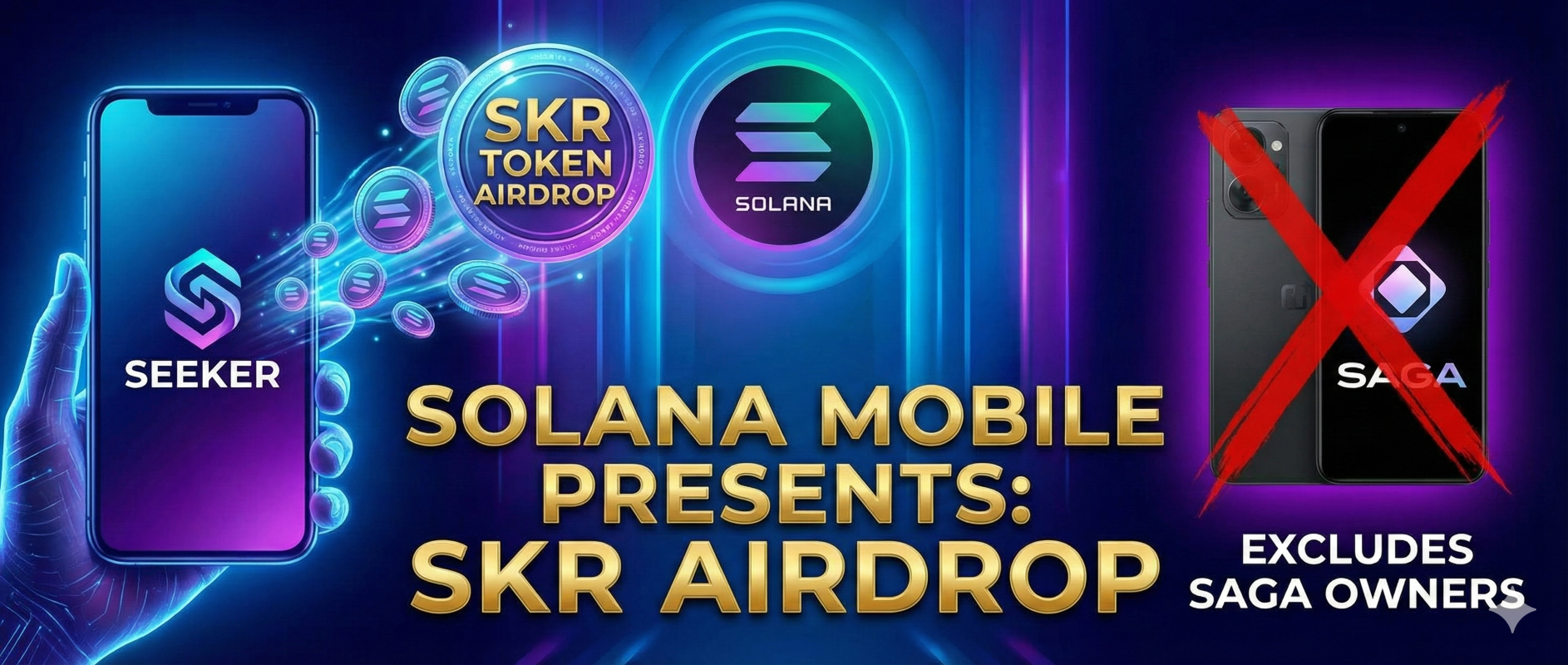
Solana Mobile Prepares SKR Token Airdrop for Seeker Phone Users, Excludes Saga Owners
Solana Mobile announced Wednesday that it will airdrop its new SKR token to Seeker smartphone users and developers within its mobile ecosystem on January 20. However, owners of the earlier Solana Saga phone will not be eligible for the airdrop, a Solana Mobile representative confirmed.
While an official post stated that the airdrop would occur on January 21 (UTC), a screenshot shared in the same thread indicates that claims will open at 9:00 p.m. ET on January 20.
The airdrop will distribute 20% of the total SKR supply—2 billion unlocked tokens—to Seeker device holders and developers building applications for the crypto-focused smartphone. In total, 30% of the 10 billion SKR token supply has been allocated to airdrop incentives.
“SKR will give everyone who helped get us here the ability to shape the success of this platform—who can participate, what rules they follow, and how economic value flows through the ecosystem,” Solana Mobile general manager Emmett Hollyer wrote. “This airdrop is the first step.”
Further details on claim mechanics and allocation are expected soon. Solana Mobile also confirmed that a snapshot of Seeker device activity was taken ahead of the token launch.
Since global shipping began in August, activity during “Seeker Season 1” has generated more than 9 million transactions and $2.6 billion in transactional volume. Season 2 began on Wednesday, with additional information expected Thursday.
Beyond the airdrop, 2.7 billion SKR tokens (27% of supply) will unlock during the token generation event on January 20, including 1 billion tokens for liquidity, 1 billion for the community treasury, and 700 million for growth and partnerships. An additional 1.8 billion SKR will unlock gradually to support future growth initiatives.
“Our plans haven’t changed—we’re building the easiest and most secure way to participate in internet capital markets from the supercomputer in your pocket,” Hollyer said. “SKR is a critical step toward an open ecosystem with more devices, developers, and users.”
More than 150,000 Seeker devices were pre-ordered following the release of Solana Mobile’s first-generation Android phone, the Saga. The Seeker retails for $500.
The Saga, which initially gained attention due to airdrops tied to the device, lost software and security support in October. As a result, Saga users will not be included in the SKR airdrop.

Trump Media plans to launch a new token offering exclusive benefits to holders
An official announcement revealed that Trump Media and Technology Group Corp plans to distribute a new digital token to its shareholders in collaboration with Crypto.com.
The planned token distribution marks another step in Trump Media’s broader push to expand its presence across financial and digital markets. Trump Media and Technology Group Corp (TMTG) operates several platforms, including Truth Social, Truth+, and the fintech platform Truth.Fi.
Under the proposal, each ultimate beneficial owner of DJT shares would be eligible to receive one digital token per whole share owned. Token holders would gain access to periodic rewards tied to Trump Media’s ecosystem, including Truth Social, Truth+, and Truth Predict.
“Such rewards may include benefits or discounts tied to Trump Media products such as Truth Social, Truth+, and Truth Predict,” the company stated in the press release.
The initiative is designed to both reward shareholders and encourage deeper engagement across Trump Media’s platforms. Distribution of the tokens will be carried out using Crypto.com’s Cronos blockchain. Trump Media already maintains an existing relationship with Crypto.com, having acquired $6.42 billion worth of CRO tokens earlier this year. The two companies also have a non-binding partnership to explore the launch of exchange-traded funds (ETFs) featuring Cronos, Bitcoin, and other digital assets.
“We look forward to utilizing Crypto.com’s blockchain technology and improving regulatory clarity to implement this first-of-its-kind token distribution, reward Trump Media shareholders, and promote fair and transparent markets,” said Trump Media CEO and Chairman Devin Nunes, according to the release.
The company emphasized that the tokens are not securities, do not represent ownership in Trump Media, and may not be transferable or redeemable for cash. Additional information regarding the distribution timeline and specific token benefits is expected to be released in the coming year.
Industry observers note that the move could represent one of the first high-profile attempts in the media sector to integrate shareholder rewards with blockchain-based digital tokens.
Following the announcement, TrumpCoin (DJT) rose nearly 16%, trading at approximately $0.00008458 at the time of writing. Meanwhile, CRO saw a more modest gain of 0.7% over the past 24 hours, trading around $0.09336.
Lighter trading platform records $250 million in withdrawals within 24 hours following its airdrop
Outflows from decentralized perpetual exchange Lighter following its recent token airdrop are not unusual, according to Bubblemaps CEO Nicolas Vaiman.
On Dec. 31, onchain data from Bubblemaps showed that approximately $250 million was withdrawn from Lighter within 24 hours after the platform airdropped $675 million worth of LIT tokens. Of that amount, around $201.9 million was withdrawn on the Ethereum network, while roughly $52.2 million exited via Arbitrum.
In a post on X, Bubblemaps questioned whether “all the (yield) farmers were leaving?”—a common concern following large token generation events (TGEs).
Speaking to CoinDesk, Vaiman said the withdrawals represent about 20% of Lighter’s total value locked (TVL), which stands at roughly $1.4 billion, according to DeFiLlama.
“While this is a large number, outflows like this following an airdrop are not uncommon,” Vaiman said. “Users often rebalance hedging positions and move capital to the next farming opportunity.”
Vaiman added that similar post-airdrop behavior was observed after token launches by Hyperliquid and Aster, and noted that comparable patterns are likely to emerge with future airdrops from platforms such as Paradex and Extended.
Natalie Newson, senior blockchain security researcher at CertiK, echoed this view in comments to CoinDesk. She said large withdrawals after TGEs are typically driven by airdrop farmers and early participants exiting positions.
“This behavior isn’t unique to Lighter,” Newson said. “We see it across many token launches. When token distribution details aren’t fully transparent, it creates a fog that allows some insiders to capture outsized gains shortly after launch.”
Ahead of the airdrop, LIT trading volume had remained relatively stable, ranging between $8 billion and $15 billion throughout November. However, DeFiLlama data shows volumes have recently dropped to as low as $2 billion. Meanwhile, LIT’s price has declined nearly 23% since Dec. 30, falling from $3.37 to around $2.57.